

















The movie Project Hail Mary (2026) is adapted from bestselling science fiction author Andy Weir‘s book of the same name. Weir’s books are known for being meticulously researched regarding orbital mechanics and physics, which is also evident in the movie.
The storyline follows Ryland Grace (played by Ryan Gosling), a former science middle school teacher, now a scientist, who wakes up from a coma with amnesia and is on a desperate mission to save the sun from “Astrophage,” an alien microorganism draining the sun’s energy. Grace develops an unlikely friendship with an alien nicknamed Rocky (because they look like a rock) and together they work to solve this crisis. As a sci-fi film, Project Hail Mary presents its viewers with complex science and engineering materials, as it is part of the process of figuring out how to save the Earth fr0m a potential ice age.
Cinematic Techniques
Thanks to my film studies teacher, Ms. Kalontarov, I immediately noticed the cinematic techniques it used. At the most climatic moment of chaos, the film chose to be silent, not letting the audience hear any sound, only focusing on the visuals on screen. In many chaotic scenes in films, directors use diegetic (what the characters hear) or non-diegetic (what only the audience hears) elements and the use of non-diegetic silence in Project Hail Mary makes these scenes more powerful.
Another thing I noticed was the decision to begin the story with Dr. Grace waking up from a coma rather than starting with the government finding him after a normal school day. Personally, I didn’t love this choice, as the constant shifts between Grace researching in space and his earlier work with Officer Carl on Earth made the narrative harder to follow. That said, I have to admit it’s not something I’ve seen done in many other films, which makes it a unique—if somewhat confusing approach to storytelling.
Visual Effects
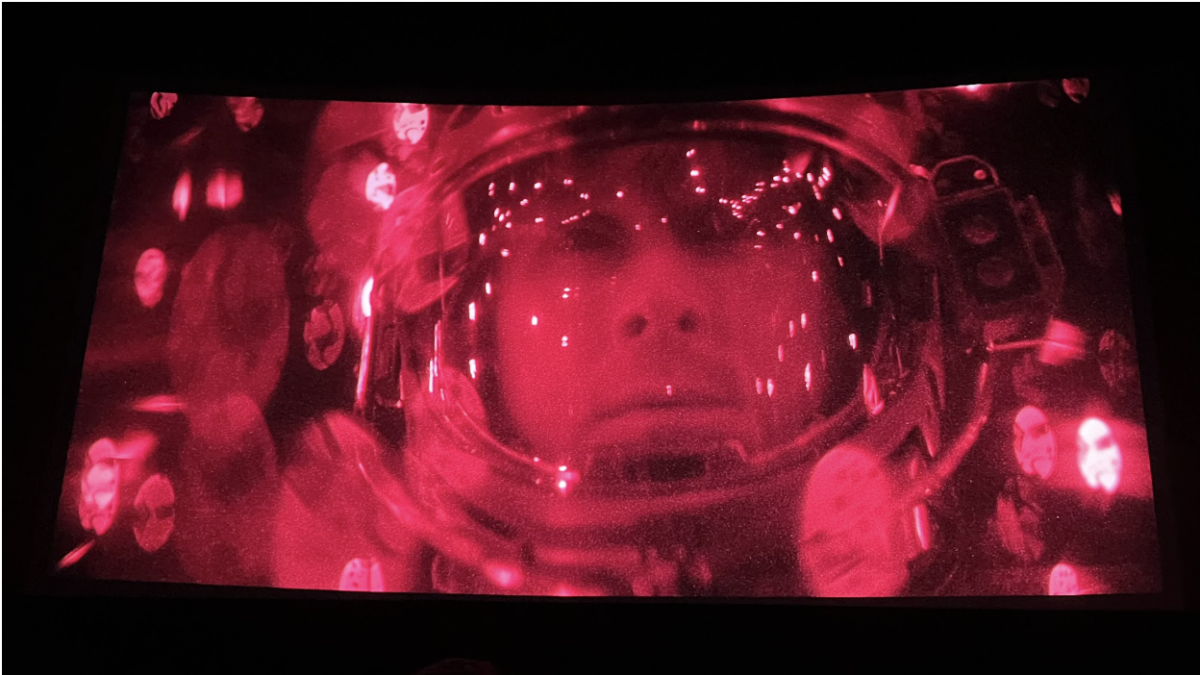
Partly because of the visuals, I think Project Hail Mary is the best movie I’ve watched in theaters so far. The visuals are stunning and captivating and as I sat in my reclined seat, I was fully immersed in the movie, and completely focused on the beauty of it. This was especially true in the scene where Dr. Grace comes out of the spacecraft and sees the only star that wasn’t affected by astrophage. The film utilizes a slow-mo immersive visual of the star, Tau Centi, and the red covering the screen is like moths to a glowing light. It was just so beautiful to witness in a theater and I don’t think watching this at home would have the same intense feeling. I think the use of practical effects and CGI has blown many people’s minds because we’re so used to seeing only green screens being used in other sci-fi movies, which in my opinion isn’t as captivating and immersive.
Acting
I personally have always liked Ryan Gosling’s acting ever since I watched his performance with Emma Stone in La La Land. I think part of what made Gosling’s acting so charming and terrific in Project Hail Mary is that because he could actually see Rocky (a puppet) and the spaceship, it made every interaction feel real and authentic.
Overall, I rate Project Hail Mary a 4/5. Although I’m not really into sci-fi films, it is definitely one I don’t regret seeing. It’s now streaming but it’s still playing in some theaters, so if you get the chance to, I would highly recommend experiencing this movie in theaters.